

Return to sender
Before blaming survey fatigue, check for inaction fatigue

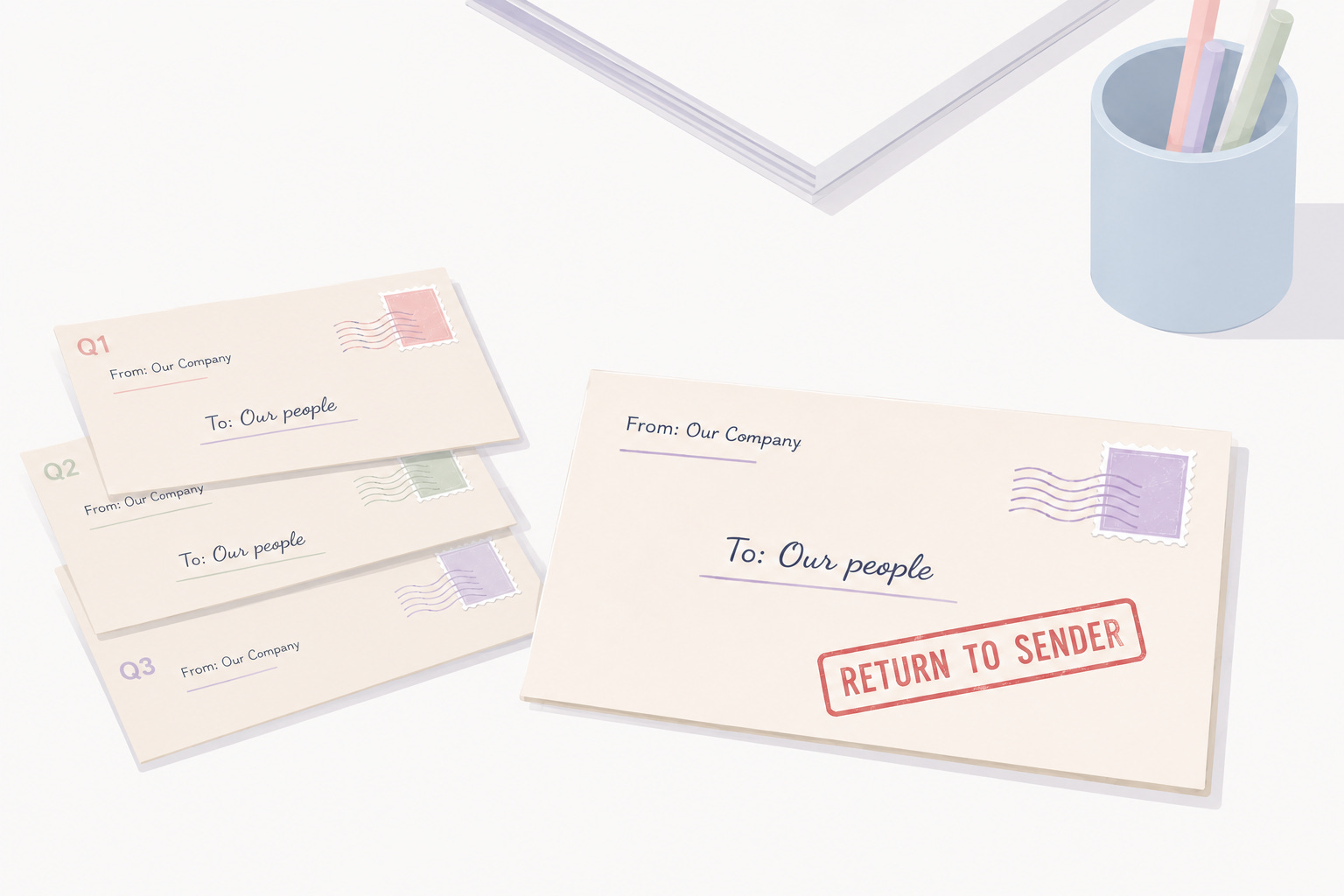
The engagement survey lands once every few months. Fifteen questions with a promise that it will take no more than five minutes to complete, and a line about how your feedback is important to the organisation. Some people open it, some even submit responses. Most ignore it.
Response rates drop. The feedback stays stuck on the same themes. The organisation reads this as survey fatigue. So it decides to reduce the cadence, or ask fewer questions. It’s a tidy diagnosis and it’s wrong. By blaming the questionnaire, or the respondents, the organisation off the hook lets itself off the hook.
The people receiving the survey may well be tired. They aren’t tired of being asked for her opinion. She’s tired of nothing happening when she gives it.
It’s inaction fatigue. The five minutes may well cost her nothing in time terms. But if she’s asked to enumerate the frictions she encounters, or the policies she dislikes, or organisational dysfunction, those things become top of mind. She notices when the friction she names in March is the same friction she names in June. She notices when the organisation doesn’t respond. She notices if the organisation says it will do something, and doesn’t.
Surveys may well die in silence, but the silence is the organisation’s, not the respondents’.
RSVP
So why does the loop stay open? Why ask at all?
This is a failure of product management.
If we think of the employee experience as a product, an experience being sold to the people who work in the company, the anti-pattern becomes clear.
If there is a golden rule in product management, it is to try to understand the problem before reaching for the solution. Listen to the customer. Get out of the building. Sense and respond.
Knowing this, you have to ask, why do organisations only do the first half when they’re running discovery on their own people?
Many organisations engage in surveys in good faith, only to find that they’re dealing with contradictory feedback, or there are issues being raised that are not within the gift of the person running the survey to resolve. In those instances, an organisation will at least respond and say what it’s hearing, and try to dig deeper. People see this, and they respond accordingly.
The deeper issue is with those organisations that never respond, or only pay lip-service to the surveys. It would be easy to be cynical and say they’re doing the survey to be seen to be “doing” employee engagement, even though they don’t want to do the hard work of changing in response to feedback. I think it’s more of a systems issue. These organisations don’t think about employees as customers of the employee experience. They see them paternalistically, as employees.
In these organisations, the leader decides what happens. It may get framed as the response to the feedback, even when it’s not addressing the concerns raised. For example, the leader wants speed, but doesn’t want to address the underlying frictions preventing teams going faster. He’s already decided what the solution is.
AI mandates are a version of this. The instruction to use AI arrives as a solution before anyone has asked what is actually slowing the work down, and whether it amplifies good practice or bad goes unexamined.

In an organisation where predictability is valued over problem solving, trust is at a premium. Bottom-up discovery asks a leader to trust that the people doing the work know where the work is hard, and that trust is exactly what a command-and-control structure is built to withhold.
Ask, don’t tell
Asking people what they want in a command-and-control structure is a little perverse. If the organisation is going to solicit feedback, it needs to be willing to act on it, and be seen to do so. It needs to run the full loop from discovery through to delivery: surface the friction, remove it, and tell people you did. A product manager who runs discovery and ships nothing isn’t customer-centric. She’s running a suggestion box with better branding. So it is for organisations and surveys. The survey is the discovery step. If the organisation fails to respond to the feedback, people understand what system they’re in, and react accordingly.
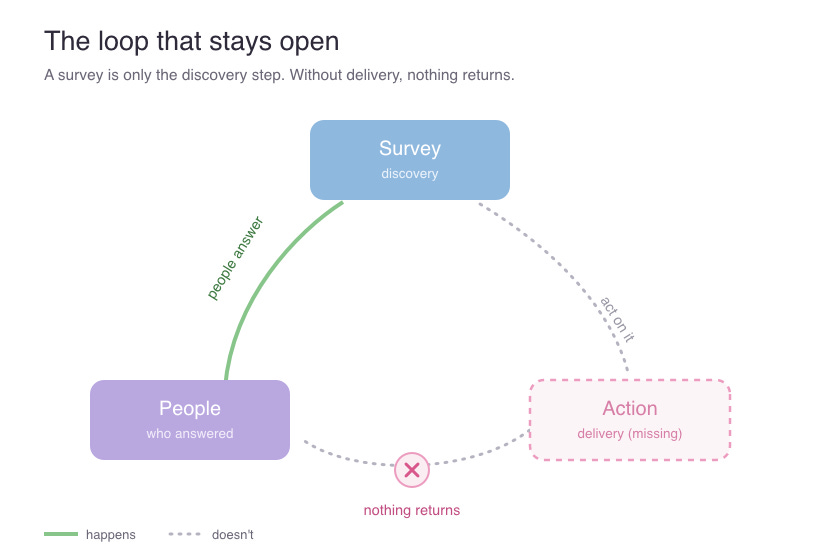
The loop closes when someone with authority decides employee experience is a first-class citizen. When being people-centric stops being a soundbite, and begins to mean that the organisation is willing to invest in its people and remove the frictions that stop them delivering.
If that sounds like it depends on finding a believer, a good leader who happens to care, I wish it were that simple. This isn’t about SuperManager donning a cape. It’s about ensuring that the organisation is ready to engage with the issues raised, however hard they may be to hear.
If you’re going to run employee engagement surveys, be aware that engagement works both ways. Be prepared to publicly grapple with the feedback. Be ready to do something, even if it’s acknowledging the feedback and being open about the contradictions or what can and can’t be done. Having seen many of these surveys, I’ve never been surprised at the things that come up. Before you send anything, find people leaders in the organisation who can represent some typical views from their teams. If they’re able to be honest with you, you’ll have advance warning of the likely themes you’ll get back and you can start preparing your action plan. If you’re not prepared to engage with what you hear, forget about the engagement survey. Your problem is not employee engagement.
The people who closed the survey email without answering didn’t have a problem with the questions. They had years of evidence about the answers. Give them a reason to believe that this time the friction gets removed, and they’ll tell you exactly where it hurts; respond with silence and they’ll do the same.