


Phase 1: Use AI
There’s a classic episode of South Park, where the gang’s friend Tweek has his pants stolen by the Underpants Gnomes. They track down the culprits to their underground cave where they uncover the gnomes’ master plan:
Phase 1: Collect underpants
Phase 2: ?
Phase 3: Profit!
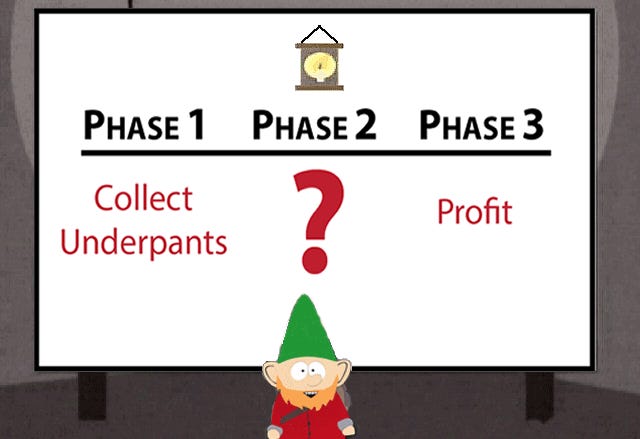
The memes quickly followed, and there’s a temptation to give the AI boom the same treatment.
Phase 1: Use AI
Phase 2: ?
Phase 3: Profit!
But this misreads the moment, interpreting the money being spent on AI as clueless investment when something far more interesting is happening.
Sure, the mandates to use AI came early, but focusing on those misses the point. When AI has achieved near-universal adoption and is generating over 50% of code, then it’s clear that engineers are using it because it’s useful, not because of any mandate. In fact, the speed and level of adoption may have taken some organisations by surprise.
Phase 2: ?
An early sign that organisations hadn’t fully understood the effect of AI adoption came with the reported impact on organisations’ budgets as token use outpaced expectations significantly.
The introduction of consumption-based billing over licences makes AI spend ”both visible and hard to predict.” Claude Code and the improvement of LLMs as coding agents have changed engineering practices quickly and in unexpected ways.
So, why not point at the gnomes with a wink or a raised eyebrow?
Because we’re living through the second act of AI right now.
The reason the gnomes meme works is that it’s patently obvious that the gnomes don’t have a plan. But when we’re all dealing with an evolving technology that’s changing practices at the same time, to paraphrase William Gibson, the future hasn’t arrived yet, and what’s arrived isn’t remotely evenly distributed.
This is what dealing with uncertainty looks like. We are living thorugh a generational shift and the only way forward is for organisations to work their way through it. This isn’t a madcap scheme. It’s a question of survival, and it’s not clear yet how to do it.
There’s a reasonable challenge coming from Finance to demonstrate that there will be a return on investment on this spend. If AI spend keeps rising, but there’s no associated rise in innovation or productivity, these pressures are understandable.
OpenAI works with what amounts to an unlimited token budget while other companies, such as Uber burn through their budgets faster than predicted. Few organisations outside the frontier labs are in a position to have an unlimited token budget, so they’re inventing Phase 2 on a budget.
This is new territory, and nobody has mapped it out. How can this be approached in a way that protects the organisation from unfettered spend while also ensuring that the budget that is spent is spent effectively?
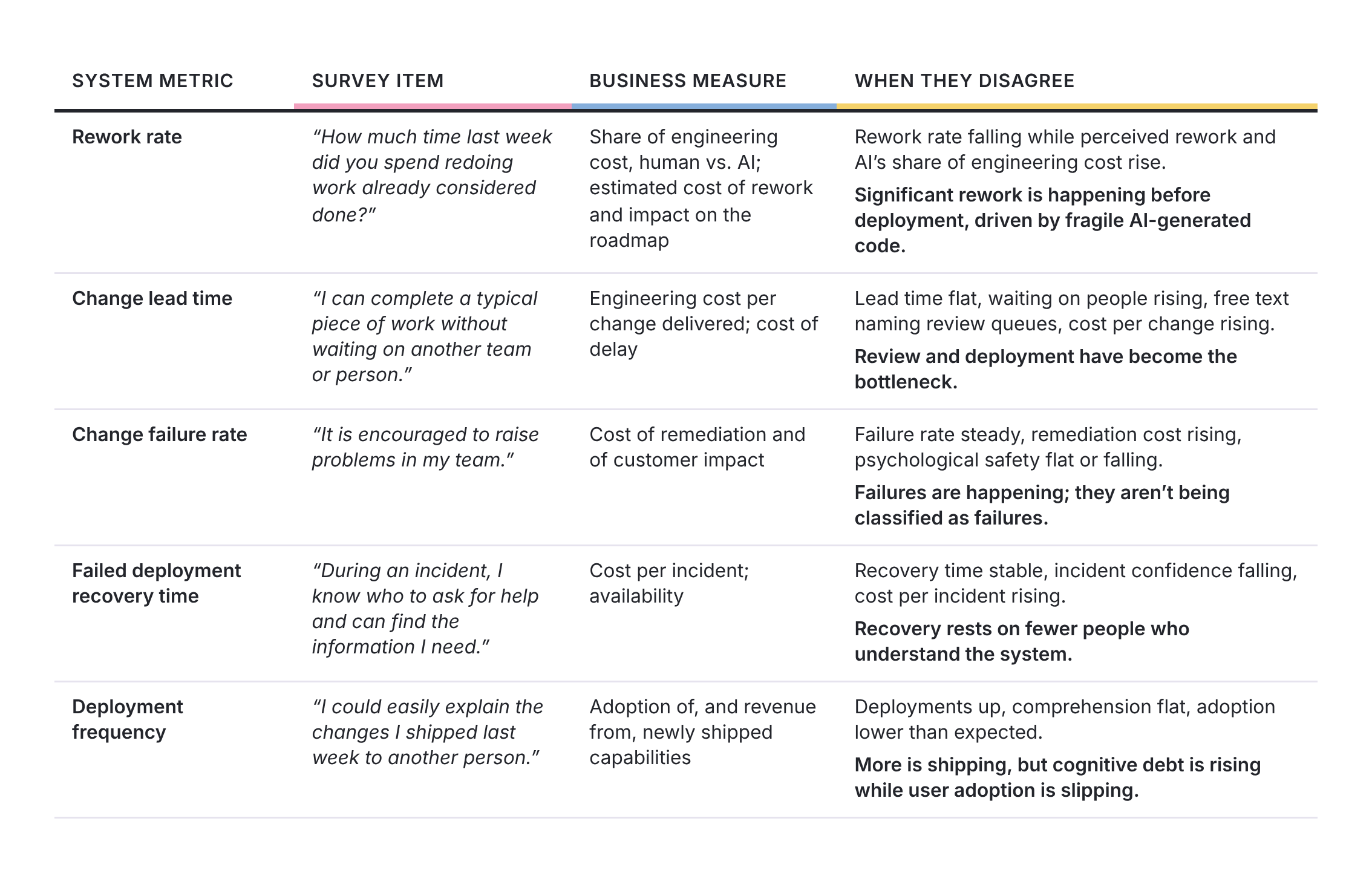
The answer is deliberate learning. At this point, the technology is moving so fast, that everything should be treated as an opportunity for experimenting and learning. It’s important to ground these experiments in data so that the organisation can learn from its investments and take action. Each experiment needs a budget and a review date, with instrumentation to inform a stop, pivot or scale decision. The metrics need to draw on different sources and check for divergence between them.
Here’s a method for doing this, using DORA metrics as system data, survey data as self-reported data and business measures as value-setting or context data.
Those furthest into Phase 2 are already changing how they build.
Phase 3: Profit!
We are beginning to see practices emerge, with common themes. Looking at Amazon’s AI DLC and OpenAI’s software factory, leading organisations are implementing practices where a human sets goals and agents plan, build, test, review and deploy with human oversight.
The software factory, in particular, seems to be an operating model whose time has come. The idea is that AI agents work together in a structured way to deliver working software with humans stepping in as required in risk-based framework. A robotic assembly line for software, if you will.
It’s a logical extension of the idea that it’s becoming impossible for human code-review to keep up, with review becoming the bottleneck that code generation was once seen as. The way through this is to have risk-based code reviews, with LLM-as-a-judge or automatic approval of low-risk changes with high test coverage and low blast radius. Human review is reserved for high-risk changes.
DORA’s ROI of AI-assisted Software Development report called out that an initial productivity dip was to be expected before gains arrive. This is the J-curve in action. Phase 2 is the expected dip. Profit! is the upswing in the J.
Even those furthest ahead are still exploring the terrain. Cloudflare openly describe the tool at the heart of their software factory as ”young and still actively evolving.”
“Profit!” will happen when standards and standardisation emerges. We’re still standing in the gnomes’ cave, figuring out what phase 2 is, even as we’re living through it.