


There’s been a week of big room planning. Dependencies are drawn, deliverables are agreed, executives have signed off. The quarter has been sliced and shaped to deliver the big rocks and experiments that are most important for the organisation.
Three days after the quarter starts, the DM comes from leadership.
“We’ve got a new ask. The team needs to size this.”
The PM argues back the quarter is full. The team are now fully loaded and focused on delivery of the just-agreed work.
“I just need to have a meeting with some of the engineers so that they can give me an estimate. It should only be 30 minutes. Are you really telling me we can’t have some engineering attention for half an hour?”
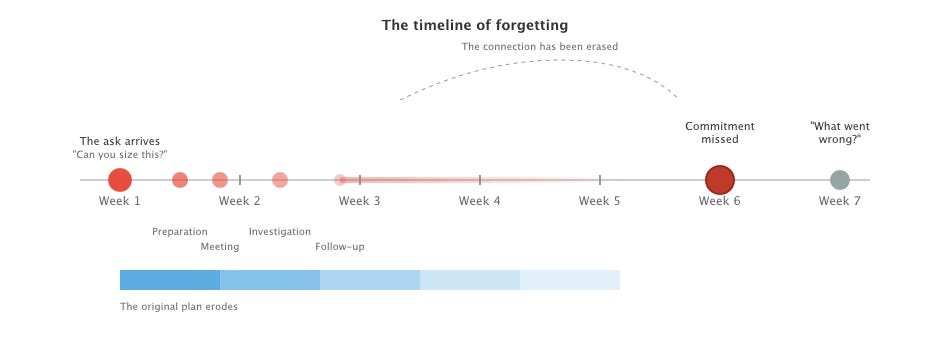
And this is how the forgetting starts.
The executive asking for something new has forgotten that this 30 minute meeting will likely need an hour’s preparation, as people try to figure out what the new ask might involve, and what the impact on the plan might be - this is the purpose of the meeting after all.
The usual outcome of this meeting is a request for more information as unknowns surface during the discussion. From the exec’s perspective, that’s perfectly reasonable - they need more input to make a decision.
But they’ve forgotten that the decision to interrupt the team has already been made. Now it’s just a question of impact. These unknowns need a day’s investigation. Another meeting is scheduled, spawning more work. And the original plan sits there, unchanged, as if none of this is happening.
The requester’s logic is sound: “I’m not asking you to build it. I’m just asking you to tell me if you could.”
But sizing isn’t free. Understanding the question well enough to answer it honestly is work. And that work isn’t in the plan.
The illusion of zero cost
The exec genuinely believes the ask costs nothing. They get their answer, they make their decision. In the meantime, the team’s planned work falls behind as the ask takes precedence. From their perspective half a week has vanished but their ‘plan’ hasn’t changed. Something has to give. Longer hours, cut corners, or a missed commitment. Any slack the team may have had is gone.

The plan assumed full capacity. Every week was accounted for. Every person was allocated. The organisation could tell itself it was maximising its return on investment.
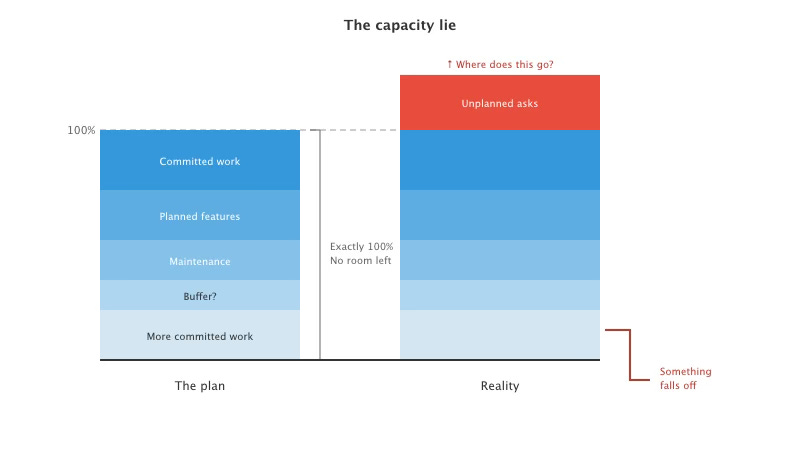
But plans built to 100% capacity have no flex. No room for questions. No buffer for the unexpected. The moment anything arrives that wasn’t anticipated, and something always does, there’s nothing to move around to account for it. Something has to give.
The failure only surfaces to the exec at the end of the quarter when the team misses its goals. By then, they’ve long forgotten about their ask. The ask and the failure are no longer connected in anyone’s memory.
The spotless plan
The plan continues to sit there, unchanging. If there are progress reviews, it’s never acknowledged that the team is effectively working on something else. Without a mechanism to reflect the interruption and its impact, the capacity taken leaves no mark.

By the time the consequences arrive, the cause has been erased. So the pattern repeats. The team keeps failing to deliver. Their reputation suffers. The asks keep coming, because they appear to cost nothing. Burnout and attrition may appear, but the dots are never joined. Like Joel waking up with no memory of Clementine in Eternal Sunshine of the Spotless Mind, we meet the same failure again and again, wondering why it feels so familiar.

What would need to change
The issue isn’t that questions shouldn’t be asked. Executives should consider alternatives, and often need more information to make the best trade-off. But raising questions while treating the plan as an unchanging and unchangeable artefact ensures failure and frustration.
Interruptions aren’t free. There is always a price to pay.
Here are a few suggestions to rescue yourself from the eternal sunshine of the spotless plan:
Plan for impact, not capacity
Too many plans focus on maximising the utilisation of every engineer. If the plan accounts for every engineer for all of the time, then the plan is a fiction. There’s always invisible work. Add the inevitable asks and distractions, and it’s clear that a plan built to 100% capacity can’t succeed. Organisations that focus on utilisation aren’t giving their full attention to what matters most - changing customer behaviours in ways that impact the bottom line. If your organisation spends more time considering utilisation than impact, the lens needs to shift.
Make the cost visible
You may not be able to change the dynamic around capacity planning, but you can name the cost. When a new ask arrives, call out what it displaces. “We can size this or do that, but it means X slips by a week.” Force the trade-off into the open. Make sure the cost is explicit. This will at least make the exec consider it. Otherwise, the pretence that it is free will persist.
Track the asks
Keep a record of what came in after the plan was agreed. When the quarter closes and performance to plan is reviewed, you’ll have the evidence to connect cause and effect. The pattern becomes visible. The memory is no longer erased.
Not right now
Ask if the request really is urgent and can’t wait. An ask that can’t wait a week probably can’t wait at all. These should be treated as a genuine emergency, not a quiet tax on the plan. Most asks can wait. Make it acceptable to say so. And make it clear that the ones that genuinely can't will blow up the plan.
Memory may fade, but plans remember what we choose to write down. The only way to escape the loop is to make the forgetting visible.