

Up and to the right
One metric to rule them all

Growth. The number that must go up and to the right.
I’ve lost count of the number of articles I’ve read in the past year speculating on Rachel Reeves’s future as Chancellor. Not because of government u-turns or her performance, but because the latest Gross Domestic Product (GDP) figures are due. The same ritual, quarter after quarter: the ONS releases a number, the headlines claim disaster or progress, even on changes as low as 0.1%, as if this single metric is the sole arbiter of economic progress.
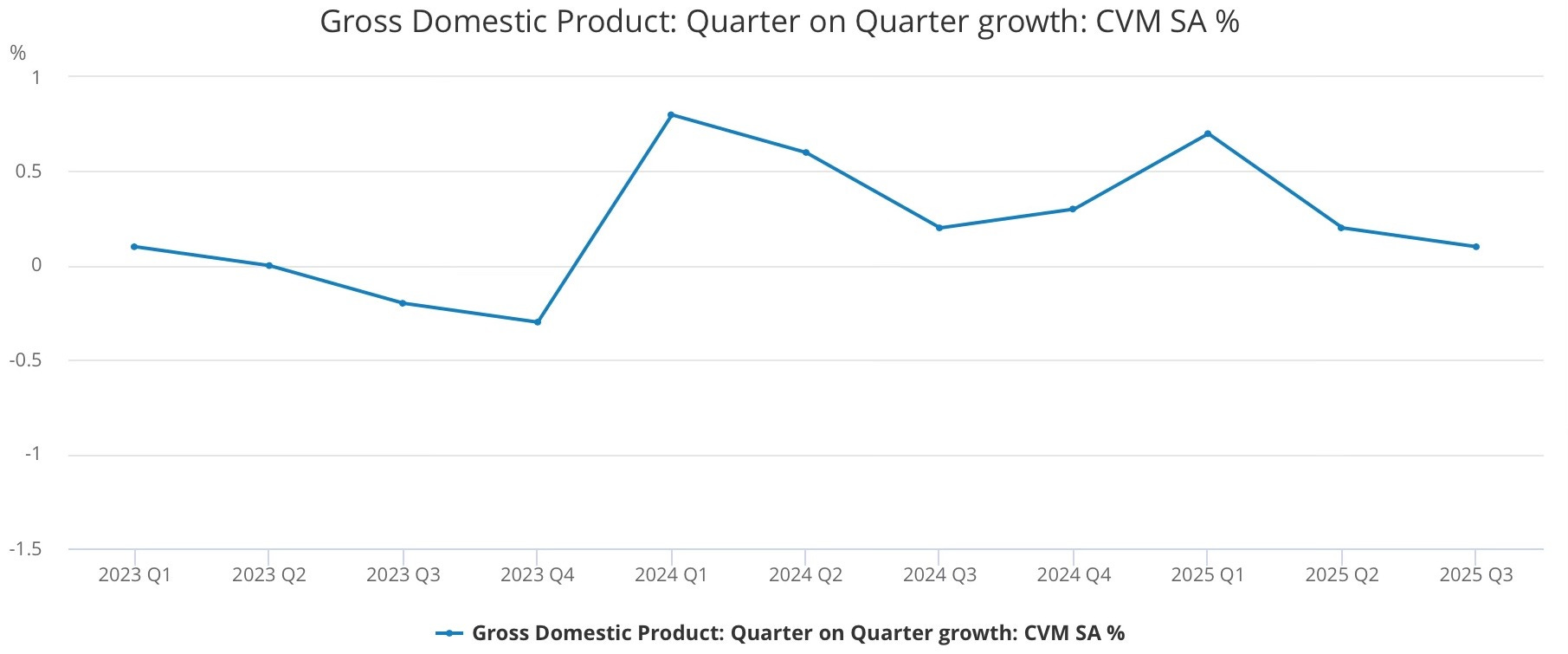
But there’s been fierce debate over whether GDP is even a valid metric for measuring economic health. GDP measures the value of goods and services produced in an economy over a quarter. It ignores quality of life, what happens in the home, investments in education, or environmental stability. On the plus side, it’s simple and easy to understand. On the other, even its inventor acknowledged that it wasn’t a useful measure of wellbeing.
GDP measures everything, except that which makes life worthwhile - Senator Robert F. Kennedy
But its simplicity is its draw. By boiling all economic activity down to a single figure, economists, politicians and journalists draw inferences on wider economic health. Widening inequality can be celebrated as long as GDP goes up. We’re burning through our planetary resources at an unsustainable rate but that’s ok as long as this measure of growth ticks up.
Widening the lens
There have been many attempts to broaden the focus of economic health measures. One that has garnered widespread attention has been the doughnut, created by Kate Raworth in 2012. The doughnut shows the sweet spot between social foundation, where the needs of all people are met, and the ecological ceiling, which is the capacity of our planet to support us.
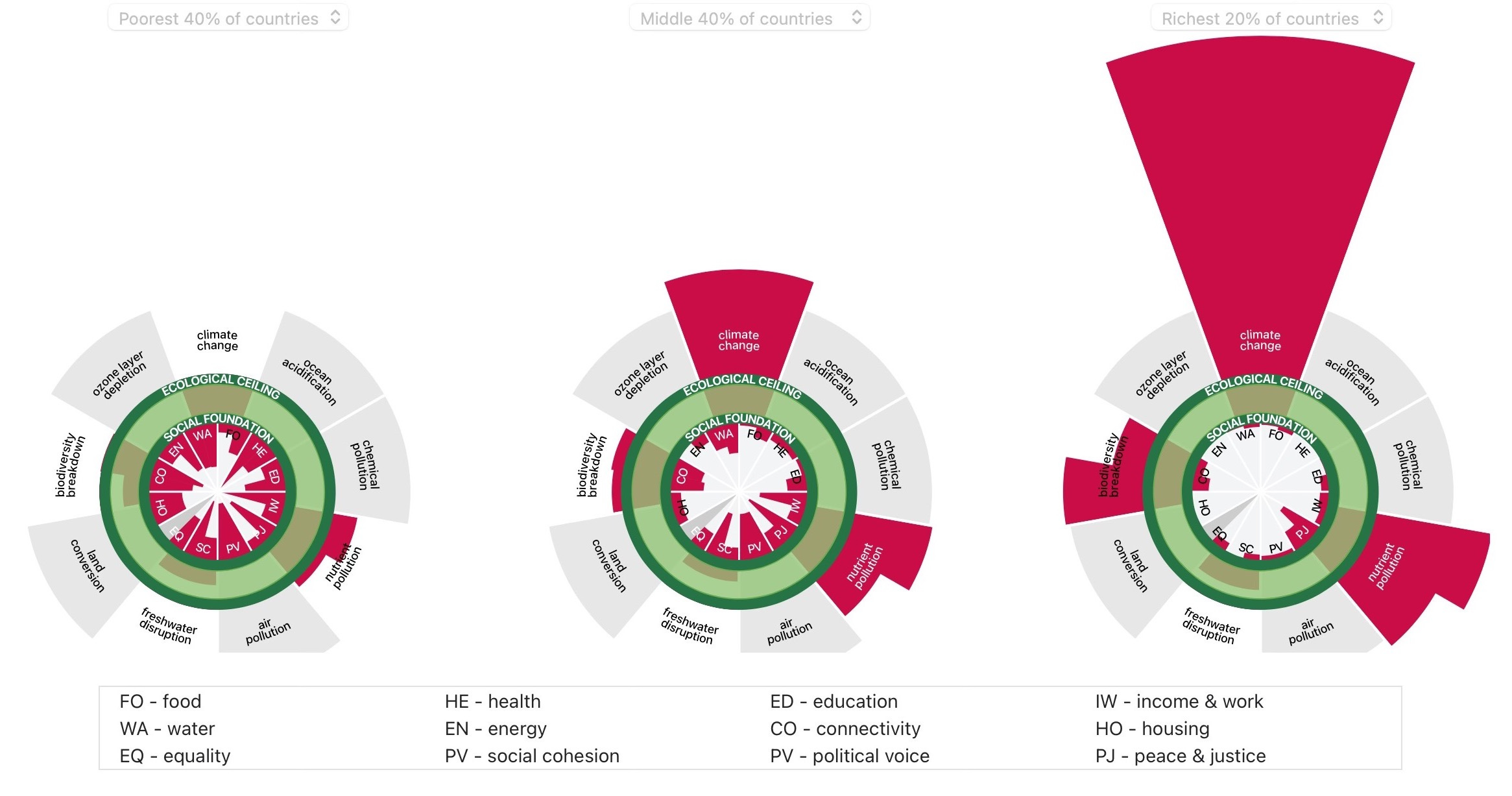
The red areas in the ‘hole’ in the doughnut show where countries fail to provide their citizens’ basic needs. In the graph above, we can see that countries, both rich and poor are failing to provide sufficient levels of peace and justice. The poorest 60% are falling behind on energy needs while the richest 40% are overshooting dramatically on causing climate change.
The doughnut looks across 12 measures of social foundation, and nine measures for the ecological ceiling. It’s an elegant overview, but its complexity means it’s a novelty for nerds. We’re unlikely to ever see a headline saying the Chancellor should be applauded because the social foundation gap has narrowed in connectivity.
What you see is all there is
It’s not that stories about such progress go unreported, it’s that they’re not given the same importance as that single number. It’s as if GDP is the pulse of the economy, and heart rate is the only measure that matters, regardless of the overall condition of the patient.
The same fixation plays out in the corporate world, with the quarterly ritual of earnings calls. These follow the GDP playbook: a number is released, analysts react to movements of a few tenths of a percent, and CEOs are declared visionaries or failures based on whether the line went up and to the right. The market doesn’t ask whether the company is building something sustainable. It asks whether revenue or earnings per share meet or beat expectations.
Following a brief reset during the pandemic, growth is back on the agenda with a vengeance. Generative AI has added rocket fuel to the boosterism, as organisations eye dramatic productivity gains and look for opportunities to cut headcount.
The AI gold rush offers a perfect case study. Companies are laying off workers citing AI as the cause while the technology requires massive investment in data centres that consume staggering amounts of energy. Failure to reach the social foundation in one metric, overshooting the ecological ceiling in another. All in the service of chasing growth.
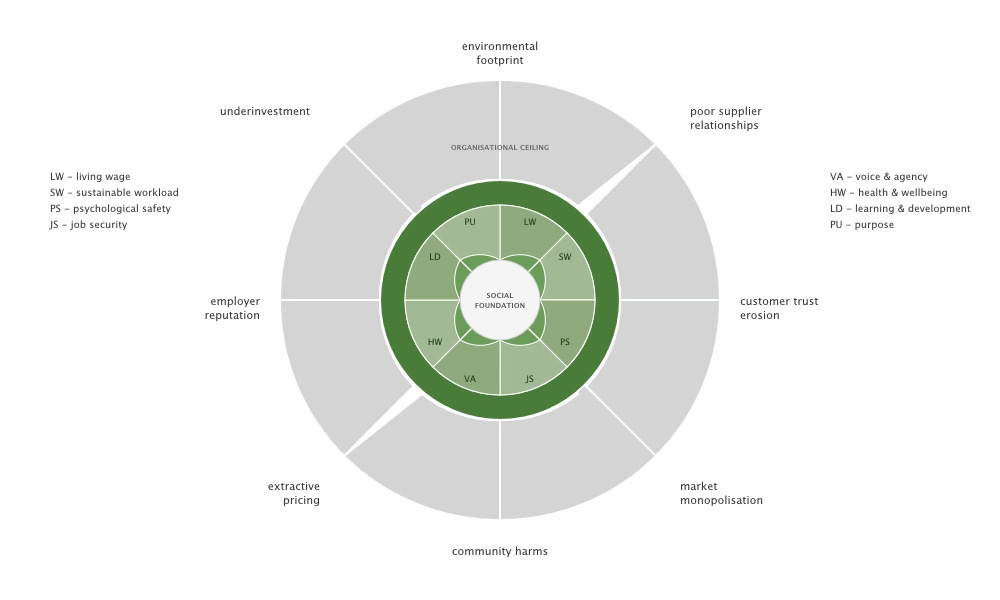
So, what would a corporate doughnut look like? The inner ring would be the social foundation, below which employees and stakeholders suffer. The outer ring would be the organisational ceiling, beyond which it would damage itself and its environment.
Social foundation
The inner ring would include sound business practices that support employee wellbeing and reward institutional health. Categories could include:
Living wage
Sustainable workload
Psychological safety
Job security
Voice and agency
Health and wellbeing
Learning and development
Purpose
Other than the living wage, these could be measured through regular employee surveys.
Organisational ceiling
Beyond the outer ring, the key measures would be around customer trust and supplier relationships, or policies that lead to the organisation damaging itself or its environment. Categories could include:
Environmental footprint
Poor supplier relationships
Customer trust erosion
Market monopolisation
Community harms
Extractive pricing
Employer reputation
Underinvestment
These don’t tend to get much airtime in an earnings call, but they’re strong predictors of whether your company will still be thriving in five years.
Doughnuts all round?
While we can imagine what a doughnut for corporate responsibility might look like, it’s hard to beat the simplicity of a single metric. Below the corporate growth headline, a lot of product organisations have “One Metric that Matters”, a guiding light for making decisions. That’s not necessarily a bad thing if other signals are also being taken into account, but if growth is the only thing that matters, well, growth is the only thing that gets measured.

Engaging with the doughnut demands attention and a cognitive load to understand the interrelationships that affect the sweet spot. It’s a great picture, but it doesn’t have the immediacy of a single figure. It remains a fantastic economic idea for nerds to noodle on, while the world continues to obsess over GDP.
It’s a fool’s errand to ask executives to put limits on their companies’ growth so they can stay in the doughnut’s sweet spot. They are subject to market and shareholder demands to deliver better financial results quarter on quarter. The doughnut is intellectually superior. The market pays the bills. The market wins.
Growth wins. It doesn’t win because it's right, but because it fits in a strapline. Simplicity beats complexity at the altitude of a country or a company. The doughnut advocates may be right, but the reasons they are right are also the reasons they won’t win.