

The most important meal of the day
Why employee experience eats customer experience for breakfast

Peter Drucker never said that culture eats strategy for breakfast.
The line turns up on slides, on office walls, on websites, as often as not credited to the man himself. It seems to have been popularised at Ford by Mark Fields around 2006, and from there it travelled, picking up Drucker’s name along the way because a good line tends to find a famous author.
I’ve come to believe the line is true at a certain elevation, but that there’s a more useful truism sitting beneath it: the employee experience eats the customer experience for breakfast. Keep going down and you reach the thing that does the actual cooking, quieter and far less quotable than either; the way the work itself is organised.
Where the cutlery goes
Walk into most organisations of any size and you’ll find the customer experience has been built with real care. There are journey maps on the wall. Response times are recorded and watched. Someone reports on customer NPS every month, and people’s bonuses move up and down accordingly.
There are voice-of-the-customer programmes, advisory boards, a CX team with a remit and a budget, perhaps a Chief Customer Officer. The vocabulary is rich and the instrumentation is good. Every touchpoint has been tailored.
The customer pays the bills. Customer numbers are how companies live and die, and if you can’t see revenue, churn and sentiment, and can’t move when they move, you’re in a world of hurt.
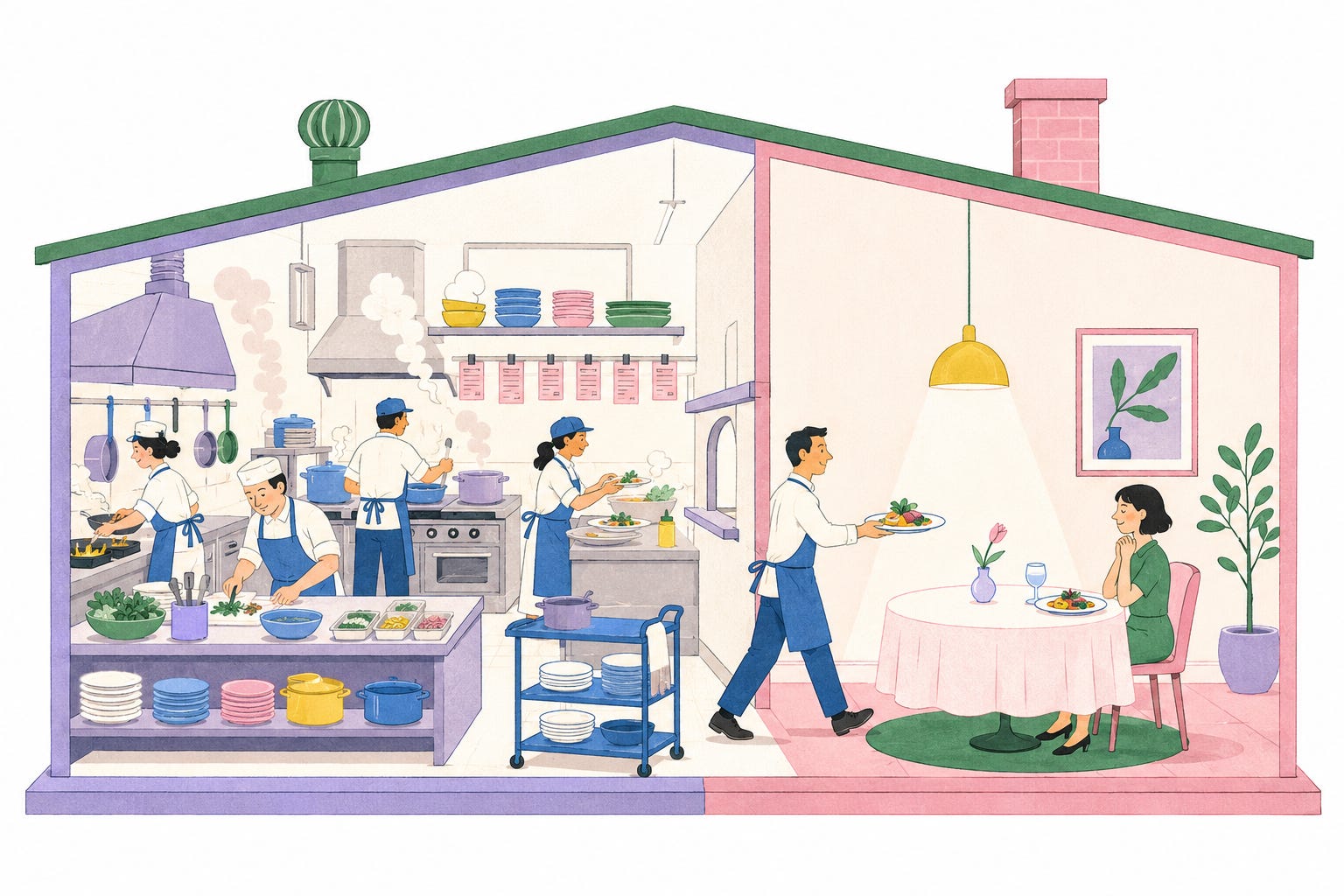
The trouble is that almost all of it is set at the table. The meal arrives there. It was cooked somewhere else.
One step removed
A customer experience is not generated at the point of contact. It’s delivered there. It was started earlier, by people working under conditions the customer will never see but will nonetheless taste.
Consider a support agent who can see exactly what a frustrated customer needs and cannot give it to her without a change that can only go on an engineering backlog following a battle with product. The customer doesn’t experience the backlog or the battle. She experiences a slow, hedged reply from someone who clearly understood the problem and then went quiet. The friction the agent lives with all day is invisible to the customer, but the customer feels every inch of it.
Or take a product manager handed a roadmap she didn’t shape and doesn’t believe in, to be delivered to a deadline set in a meeting she wasn’t in. She ships what she’s told to ship, and is rewarded for it. The customer never sees the PM, never gets to influence the roadmap. He gets a product that doesn’t quite fit the way he works, a thing built to be announced rather than used.
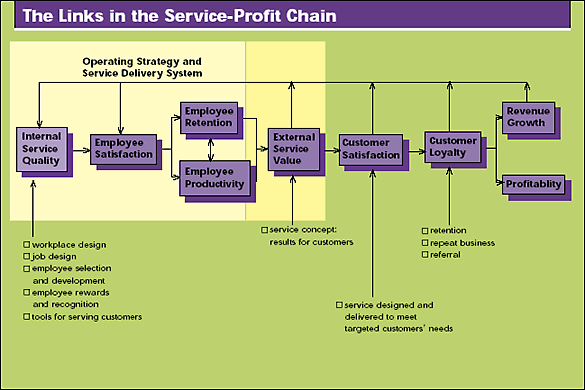
Neither of these is a touchpoint problem. Neither, quite, is a culture problem. They are problems with how the work is arranged: who can act, who has to ask, who owns the roadmap, where the power sits. The importance of the operating model being aligned has a lineage back to the service-profit chain, written up in the Harvard Business Review over thirty years ago: internal service quality shapes employee satisfaction, which shapes loyalty and productivity, which shapes the value customers receive, which shapes their loyalty, which shapes the revenue. A chain, with the customer near the end of it and the conditions of the work near the start. In most organisations the investment is all at the end, polishing the last link while the early ones rust.
What culture is made of
Which brings us to the word everyone reaches for. When the customer experience is poor and the touchpoints are already polished, someone says the problem is culture. They’re not wrong. But culture is not a thing you can write up on a slide deck and share. It’s the result of a thousand decisions about how work is organised: who gets to act, who has to ask, what gets rewarded, whose name is on the roadmap. Change those and the culture changes, whether you meant it to or not. Leave them, and no values poster, no offsite, no engagement survey will shift it.
Culture brings the meal to the table. The customer experience is where it’s served.
Set both places at the table
So the employee experience matters, and it rarely gets the attention the customer’s does. Often it’s handed to HR and turned into a perks programme; better snacks, a wellbeing app, an engagement survey nobody acts on. That isn’t the employee experience. That’s the décor around it.
The employee experience that actually feeds the customer is the operating model. It’s whether the work makes sense. Whether a person can act on what she sees without filing a request and waiting a fortnight. Whether decisions sit with the people closest to the problem. Whether the roadmap belongs to someone who believes in it and has the autonomy to change it. These are operating-model questions, not morale questions, and they are the ones that settle into a culture and surface, in the end, as a customer experience.
I ran operations for a fast-scaling business through a long stretch of growth, and I learned this the slow way, by getting it right and not understanding why until later. I cared about the customer, but caring was the easy part; everyone says they care about the customer. What made it real was that I designed the work to match. The touchpoints were documented, and so were the processes feeding them. People could act on what they saw. Decisions sat close to the problem. The operating model let the teams be good at what they did, and they became fiercely proud of it. The customers felt the difference in every interaction. I used to think I’d built a culture, but I realise now that I built an operating model, and the culture was what grew in it.
Get the work right and the customer experience follows, not because culture is magic but because the customer experience is a downstream reading of how the work is done. Fixing it at the customer’s end, with a new CRM or a better script or a tone-of-voice guide, is treating a symptom where it surfaces. Satisfying, visible, and not addressing the underlying condition.
Another contested attribution: John Lennon wasn’t the first to say “Life is what happens to you while you’re busy making other plans.” Your customer experience is what happens while you’re busy deciding how the work gets done.