

Money for nothing
Why don’t customers pay for outcomes?

Last week, I re-read Jeff Gothelf and Josh Seiden’s book, Sense & Respond, and a story in it has stayed with me since.
A government client in the United States came to their company wanting a new communication platform to connect a state with its constituents. The client’s goal was to reduce the millions it spent on postage every year by enabling services electronically. They arrived with a long list of the things they wanted built, by a date, and an assumption that the list would deliver the saving.
So far, so typical.
Then, Gothelf and Seiden did something most suppliers never would. They proposed being measured on the saving rather than the list. They wanted to run experiments to test the assumptions, then build toward the outcome the client actually wanted. They wanted to be measured on the reduction in postage costs rather than by what got delivered.
This doesn’t usually happen.
The thing we actually reward
Why doesn’t this happen more often? How is it that organisations don’t look for the outcomes their customer wants?
Often, it’s because, like in this situation, the customer turned up with a list of features, assumptions and a timeline. Work often comes in like this, and not only in government contracts. It is the default almost everywhere, and it runs in both directions.
Inside a typical product organisation, throughput is a key measure of success. Emphasis is placed on delivery. Customer value is harder to measure, and, thus, often isn’t. John Cutler found that in many organisations, where stakeholders prescribe work, “they are trying to make things easier for YOU — easier for YOU to staff your teams, plan your workload, and make reasonable commitments.”
In consultancies, the incentive is billable hours. A customer turns up with a budget and a list of requirements, the conversation instantly moves to “how much” rather than “how do we know if we’ve achieved your desired outcome?”
The customer wants the certainty of price and deliverables; the consultancy wants to bill based on time and materials. Utilisation, the share of a consultant’s time that is billable, is the number every firm watches. It rewards keeping people on the clock regardless of whether the clock is pointed at anything that matters. The engagement closes when the work is delivered, not when the client succeeds.
Gothelf and Seiden’s client declined their offer. Budget approval sat with the state’s attorney general, an elected position, and it was an election year. They didn’t want to focus on outcomes. They wanted a fixed set of deliverables they could point the electorate to. So the supplier who offered to tie its fee to the customer’s success was sent away, and the work presumably went to whoever would promise the list.
The caution looks like guarding public money, but buying a list of deliverables commits the taxpayer to paying for whatever gets built, regardless of whether the postage bill ever falls. So why does this approach win out?
Both hands reach for the deliverable
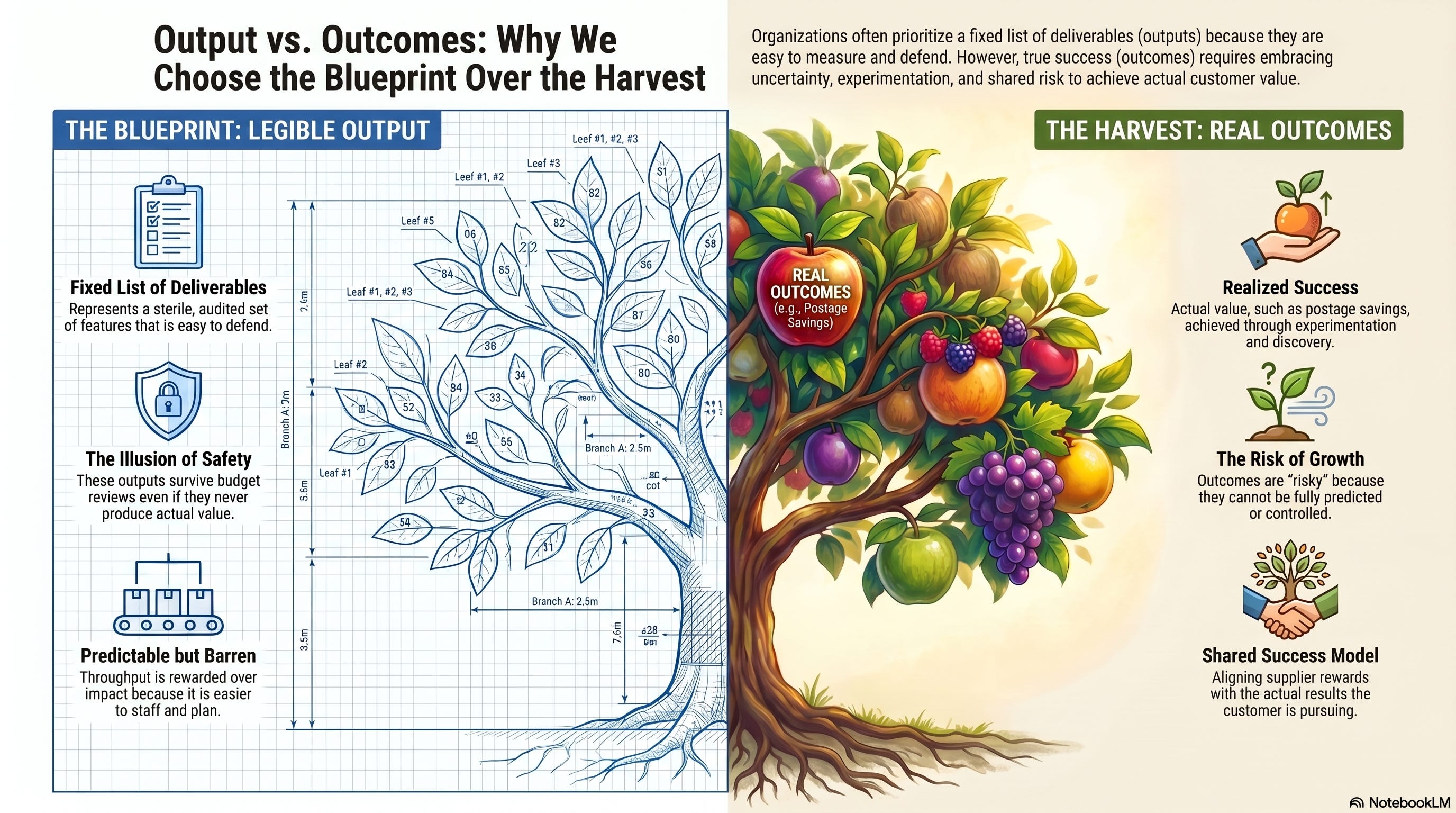
The attorney general reaches for a list because a list is something that can be defended in an electoral race. The internal sponsor defining a roadmap is doing the same thing. Both reach for the deliverable because the deliverable is the thing you can point to when someone asks what you got for the money. Output is legible. It survives an audit. The customer’s outcome can be slow and contested. How do you draw a straight line between output and an outcome? Given the pressure of budgets and performance reviews, it makes sense to reach for the legible number.
Why the safe thing wins
If we accept Marty Cagan’s warning that at least half of our ideas won’t work will fail, then output becomes the thing you can reliably show. The incentives for stakeholders and customers to measure output instead of outcomes are clear.
Output is safe and outcomes are not.
Owning an outcome means agreeing, in advance, to be measured on something you do not fully control, and then carrying the loss if the world doesn’t cooperate. When I ran a small company, I set the prices and I owned whether the work paid: survival is the base measure of success for a startup. Paying the bills and keeping the lights on is existential. People’s appetite for this kind of risk is small.
Shared success
A shared success model ensures that everyone is aligned around the goals of the customer, with some aspect of the engagement allowing for discovery and experimentation. The supplier wins when the customer wins. The fee, the engagement, the team’s rewards, are all tied to the result the customer is pursuing. Experimentation and learning enable you to work out the path. The idea is to move away from guaranteed deliverables, to discover what works.
It is rare to see this model implemented, and this is because of incentives. When output is the goal, then a flawless execution of that output is rewarded, regardless of customer value. This is safe for stakeholders and suppliers. Shared success forces both sides to define the outcome and to share the risk of missing it. That is harder than it sounds. An outcome is never wholly in either party’s gift; a supplier can do everything right and still miss it if the client does not act on the work, and the buyer signs up to a price she cannot fix in advance. The reluctance is rational, not timid.
However, this approach can build partnership across engagements and contracts. The supplier can demonstrate their commitment to the client by aligning some elements of their pricing with achieving outcomes while the buyer accepts that some parts of a project cannot be fully predicted. Trust follows when both parties are willing to take a risk.
It also has real value in ways that may not be initially obvious. When you are on the hook for the customer’s outcome, work that produces no outcome stops being someone else’s problem or billable hours, and starts being your loss. The thing that keeps people busy but is going nowhere now costs you directly, so you end it, not out of virtue but out of self-interest.
On the hook
We worry about the supplier who builds too much and bills for it. We worry far less about how few people, on either side of any deal, are ever paid for the customer actually winning. The product team is paid to ship. The consultancy is paid for its hours. The buyer wants a list she can defend. Everyone is paid for the deliverable, and the customer’s success is left to look after itself.
Gothelf and Seiden offered to be paid only if the customer won. The customer said no. We worry about people taking money for nothing. The stranger thing is that when someone offers the opposite, almost nobody can take it.