


Why it matters
In the age of AI, companies that can't adapt quickly face existential levels of risk. They’re no longer going to be able to protect market share with the same old strategies. They’re facing irrelevance, possibly even going out of business. No company has a divine right to survive. Even Google’s dominance in search may be showing the first signs of cracking.
The ability to change may be the only sustainable source of competitive advantage in this future.
This hit me when I listened to an old episode of Dave Farley’s podcast The Engineering Room, where he interviewed Matthew Skelton, one of the co-authors of seminal book Team Topologies.
It’s a great episode, packed full of actionable insights, but one line in particular leapt out.
The ability to change your software is the defining characteristic of its quality - Dave Farley
We know from the work done by the DORA group that batch size and frequency of changes are strongly correlated with code quality and good developer experience. So, this statement should have just had me nodding along in agreement. But instead, I realised that the same thing is true for organisations. Just as code quality can be measured by how easy it is to change, organisational health can also be measured by how easy it is to introduce change. At a time when adaptability is becoming key to organisational survival, how can we make change easier in our organisations?
As anyone who’s ever tried to introduce any kind of change to an organisation knows, change is hard.
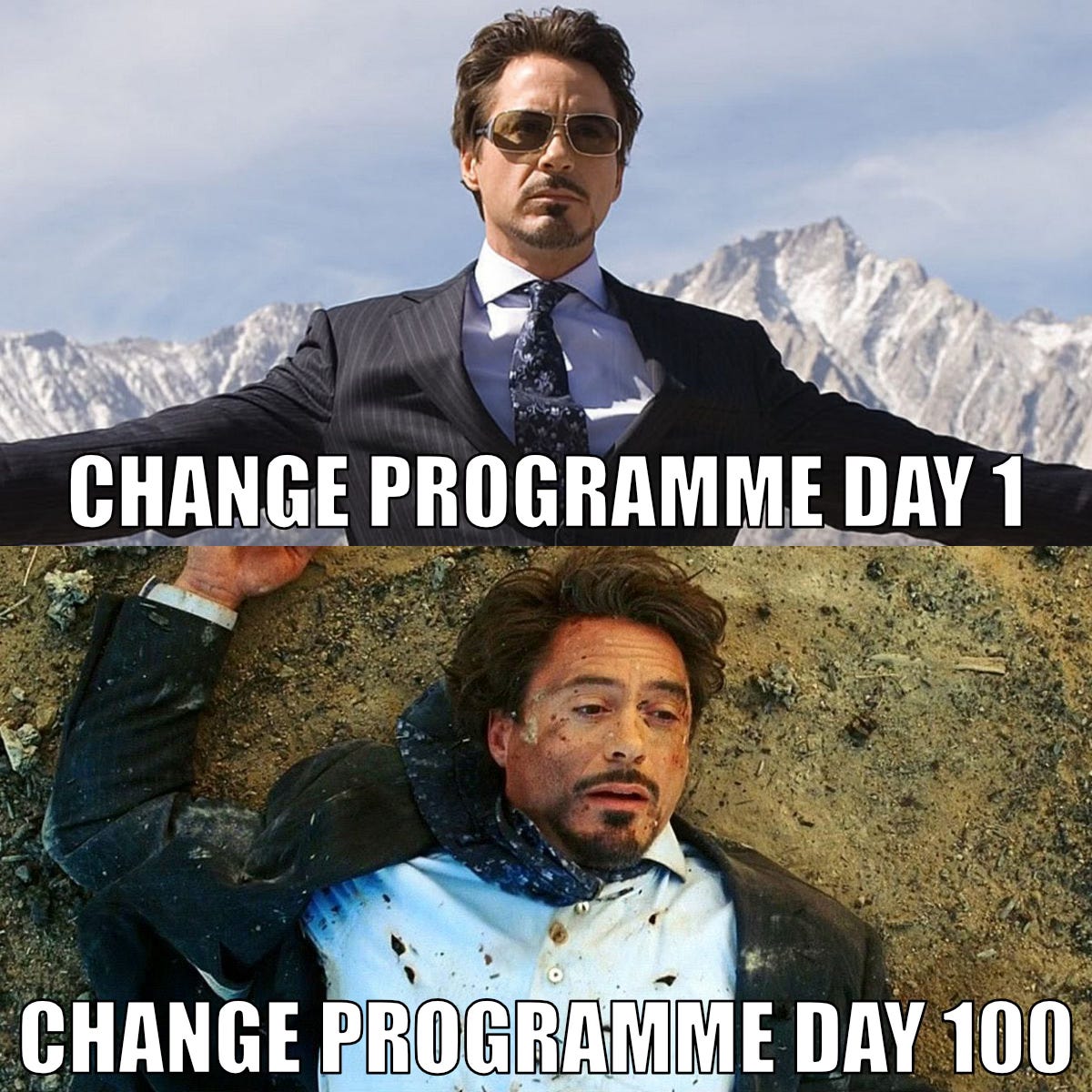
We’ve all been there. A new process, a new initiative, apparently sensible, definitely well-intentioned, runs into the ground.
Some of the main reasons that changes (big and small) fail are:
Fear of the unknown/uncertainty anxiety
We’ve always done it this way/the weight of history
Lack of buy-in
Lack of trust
Politics
Let’s start with probably the most universal of these - the fear of the unknown.
Uncertainty anxiety
What it is
Change makes lots of people uncomfortable. They can be fearful about the potential loss of status or feel threatened by changes. This can be made worse by the fear of failure among the people who need to lead the change.
Early in my career, I took on a major project at an energy company. One of the reasons I got the chance was because none of my more senior colleagues stepped forward. I could see the hesitancy in meetings when the project was raised. It felt like everyone else was backing away, as if trapped in a cave with a particularly grumpy bear. All I could see was a problem that needed solving. When I volunteered to take it on, a colleague turned to me and asked, ‘what if you fail?’ I responded, ‘what if I succeed?’ That project did succeed, opening up a new market segment of several million euro and it turbo-boosted my reputation within the company.
What to do
It’s important to acknowledge people’s legitimate concerns when embarking on a change, big or small. Sharing information about the reasons for the change and the measures of success that will be used can be critical in giving people some security, which in turn can be the difference between success and failure. Having a plan for what you’ll do if the change doesn’t yield the expected results is always a good idea.
However, be aware, that even when you address the spectres of the future, you’ll still have to address the ghosts of the past.
The weight of history
One of the biggest barriers to change is the historic experience of the organisation. This manifests itself in two ways. There’s ‘but this is the way we’ve always done it around here.’ and ‘we tried that before, and it doesn’t work.’
This is the way we’ve always done it
What it is
It’s easy to hear ‘but this is how we’ve always done it’ as an excuse, It’s likely to be grounded in anxiety rather than any real attachment to the current process. But you need to respect it, all the same. Culture is ‘the way we do things around here,’ so change handled indelicately can be seen as a direct attack on the culture.
In another role at the same energy company, I was tasked with reviewing our approach to a particular market segment in the light of new market rules. We hadn’t changed our approach after these changes, and were losing out on revenue as a result. When I dug into this with the responsible team, the response I got was ‘this is how we’ve always done it.’ I addressed this by creating a pack for the team on how the market had changed, and shared with leadership the potential benefits of a new approach. By sharing the benefits of change from a commercial perspective with leaders, and an operational perspective with the team, I was able to get support for the new approach, and see this successfully implemented, leading to a substantial increase in profits from one market segment.
What to do
Similar strategies to those addressing general anxieties will help here. Explaining the ‘why’ and what you’ll do if the change doesn't work should help assuage concerns. Often the most important question you can answer is “What’s in it for me?,” directly addressing the reasons that moving on from current practice is in their interest.
In addition, sharing any data or evidence you have supporting that the current way of working is no longer fit for purpose may change minds. If it’s possible to run the two processes alongside each other in some way, e.g. roll the new process out in one team, and keep the current one in another, and measure the results. Data should beat opinion.
We’ve tried that before, it didn’t work
What it is
The second historic concern requires more consideration. The quote often misattributed to Einstein springs to mind:
Madness is doing the same thing repeatedly, expecting different results.
In one role, I was leading a small change to the company’s systems, in an area adjacent to the one where I usually worked. We had implemented a similar solution in my area, so I was confident it would also be successful here.
It was an utter failure. After about a week, it became clear we were on the wrong path and abandoned the effort. I spoke with one of the team managers a day or two later, and he said “I knew that wasn’t going to work.” It turned out that the same thing had been attempted on their system with the same results a few years before. “Why didn’t you tell me?” I asked. He shrugged. “You seemed so sure.” I realised I hadn’t shown enough curiosity about the team’s previous experiences, and just assumed our solution would work, as it had in other areas.
What to do
It’s worth digging into the circumstances surrounding previous efforts with the local historian (there’s always a local historian, that person who’s been around a few years, who can tell you all about the way things have changed, and what’s been tried before.
It’s possible that you’re genuinely repeating history, i.e. trying to solve the same problem in a way that failed before, without a change in circumstance. If this is the case, go back to the drawing board. The only thing that will happen if you continue is that you will lose credibility.
If you’re genuinely approaching the problem in a novel way, or have identified a novel problem, explain this to the teams and people concerned. If you help them understand why this is different, then you’re halfway there. But dealing with what happened in the past will only help you succeed if you can also get people to support you and the change you’re trying to deliver.
Trust and buy-in
What it is
People may doubt the motivations behind the change, or suspect that you’re not acting in either their best interests or those of the organisation. If this is the case, then you’re likely to encounter a lot of resistance. If you’re not from within the space, it’s easy for people to doubt your credibility and understanding.
If you’re dealing with a team or department that’s got low morale, you may encounter learned helplessness, where they believe that nothing they do to change will make any difference to their situation.
Sometimes, teams are exhausted by a constant onslaught of changes. If there’s a number of simultaneous changes or initiatives happening at once, yours is likely to get lost in the noise, or resisted simply because it’s one more thing for an overloaded team to deal with.
Learning from my experience above, where I failed to explore the lessons of history, I’ve made sure in more recent years to share thoughts early on change and the reason for it. Rather than dreaming up solutions in isolation, I’ve built trust with the team by introducing the problem and the impact that it has to them and the wider organisation, and inviting comment, often co-creating solutions with them . This approach builds trust and giving the team a sense of ownership over their own destiny.
What to do
Be humble. The people you need to implement a change need to believe in it. Spend time explaining how the change can improve their circumstances or outcomes. Look for quick wins, if any are available, to demonstrate improvements.
If teams are in a constantly-changing environment, or complain about the number of initiatives they are being subject to, then you can look at the timing of these changes and see what you can do to reduce work-in-progress.
Establish credibility by being transparent about the risks and potential benefits of the change. Listen to people’s concerns, particularly if they’re trying to explain some complexities or dependencies you may not have considered. If there are particularly sharp concerns, offer a trial period, or run a comparison between old and new processes.
Bear in mind, though, that if you want to achieve any more than local success, you’re going to need to get senior leaders to unite and back you.
Politics
What it is
Most of the issues above assume that resistance comes from within the team or department expected to implement the change However, you shouldn’t underestimate the power of peers or of those above you in the organisation to block your change. This could be motivated by perceived loss of control, a lack of consultation about changes that impact them, or even because of personal animosity or organisational power struggles between leaders.
One approach that can work is nemawashi. Nemawashi literally means ‘preparing the roots.’ It refers to the practice, common in Japan, of meeting key stakeholders well in advance of any decision, and building consensus. Stakeholders share their feedback on the problem, the proposed solution, so that agreement emerges around an approach. This way, by the time a decision needs to be made, it is uncontroversial.
I took this approach when dealing with a cross-functional change at a large organisation where similar efforts had been derailed before they had left the station. I noticed that if any one department proposed changes, the leader of another would usually ensure that it got shut down before it could progress. I made sure to meet with all of the potential stakeholders, sharing thoughts and adapting the proposal based on their feedback, so that by the time it came to approve the initiative, all potential roadblocks had been dealt with in advance, and the change was well-supported.
What to do
Build alliances. Make sure you make people around you and above you in the organisation aware of what you’re trying to achieve and how. Be especially clear on what’s in it for them. It’s a good idea to start sharing your thinking with any interested and potentially-impacted parties as early as possible. By the time you get to a decision point about implementation, you should know the position and ideally have the public support of all of the leaders you need in the organisation.
Making change easier
If culture truly is ‘the way we do things around here’, then our company’s survival depends on making change ‘the way we do things around here. Change is the one thing we can guarantee we’ll have to contend with as advances in technology will continue to disrupt jobs and the world in ways we can’t conceive of yet.
Building partnerships that can support and drive change forward will be vital. You can make change easier if you consider the potential barriers to change in advance and create strategies to overcome them.
The ability to change your business or product is going to be the defining characteristic of its success.
Four strategies to make change easier in your organisation
Treat concerns with respect. Build trust by openly engaging and listening to people’s concerns.
Acknowledge uncertainty. Share your measures of success and what you’ll do if the change fails.
Agree the problem with your teams, and co-create solutions. Check with the ‘local historian’ what approaches have failed before and make sure everyone understands why this is different.
Use nemawashi to build consensus among leaders on the problem and your approach. Investing time early in stakeholder management will reap dividends later on, as you’ll be able to overcome obstacles before they become blockers, and learn the different perspectives in the business.
One critical question
In any change conversation, be aware that the other person doesn’t have your context. They may be concerned about the uncertainty of change. They may be cynical because of what’s gone before. They may have concerns about what’s driving this change, or its impact on their status in the organisation. Prepare for each conversation by putting yourself in their shoes and asking the critical question that will help overcome their reservations. “What’s in it for me?”
The stakes have never been higher in getting change right. That’s what’s in it for you.