


Asking to be well done

When is something done?
Often, it depends who you ask.
Done can mean different things to different people. I’ve heard teams describe done as needs testing, not yet deployed, ‘code-complete’ (whatever that is), and deployed.
This kind of incoherence afflicts scale-ups and larger organisations as teams grow and new, independent teams start to build and release software. Different practices emerge, and, one day, you wake up to find that there are conflicting practices across the organisation. People use the same terms to refer to different things, and the ambiguity slows everything down. Nobody can say for sure when a piece of work is finished because everyone’s arguing from their own perspective.
At this point, the organisation reaches for a ‘Definition of Done.’
Shared language, shared failure mode
The aim is to give the organisation an agreed contract and shared understanding, and it usually follows something akin to what’s in the Scrum Guide:
It’s done when the team has delivered an increment. Not necessarily deployed it, but there’s software written that can be used by someone (even in theory).
A shared definition of done allows the organisation to have a common language. Standardising ends the noise, but it also ends the asking.
I think this is where most Definitions of Done stop, and it’s too early. The agreement removes any stimulus for the team to see how the work is received. It’s complete. It’s time to move on to the next priority.
This is where the question of customer value dies. If the team doesn’t own it, there’s nowhere else for it to go.
The organisation is right to reach for consistency. It reaches for it at the wrong point.
The consistency of definition spreads the lie of completed work around the organisation.
Getting done in stages
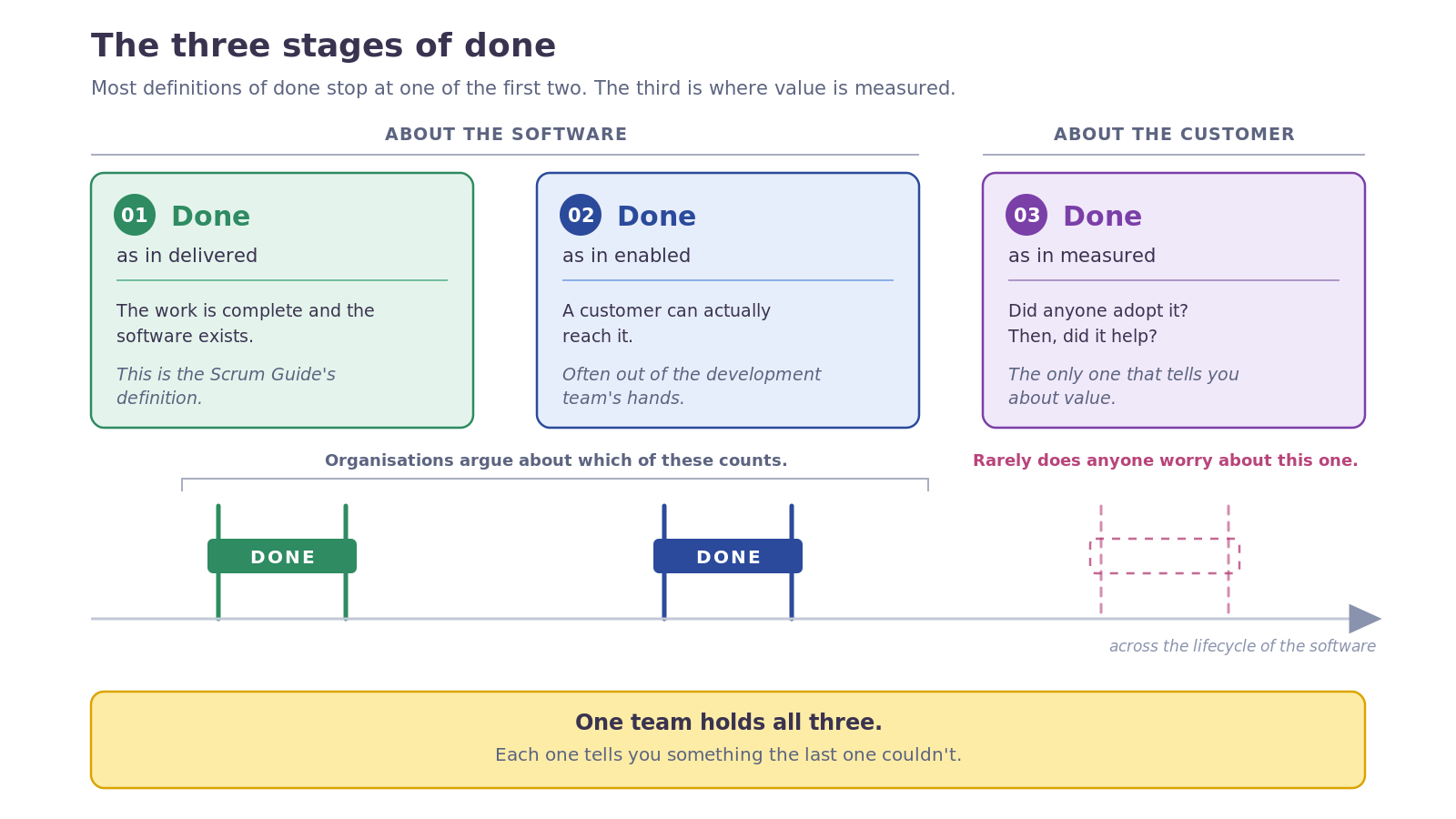
A true definition of done operates across the lifecycle of the software in production. I don’t mean different definitions for Epics and stories, or for features and releases. There are different stages to done, and each one tells you something the last one couldn’t.
The first and most obvious ‘done’ is the one supported by the Scrum Guide and most definitions. The team has completed work and delivered software.
The second ‘done’ occurs when the software has been deployed and can be used by customers, often referred to as ‘enabled.’ Software can be built, have passed the first done, and still not be available to a customer. This may be because it’s feature flagged or because it’s a B2B where implementation happens independently of the development team, e.g. a CSM schedules going live with a particular capability for a customer.
I’ve sat through many debates about which of these two is valid. Whether something can be considered done when it’s not deployed is the cause of considerable angst in some organisations. Rarely does anyone worry about the third stratum, to my mind the one that matters most.
The third ‘done’ is the one where value is measured. Once the software is enabled, the team needs to know if it meets customer needs. If the team had a hypothesis, this measures the outcome, and delivers valuable feedback to the team and the wider organisation. Without this third stratum, the team has no idea whether they built something that solves customers’ problems.
This measurement answers two questions, and both are important.
Firstly, did anyone adopt the software? If nobody adopted the software, one of two things must be true. Either nobody found it, which says the organisation never aligned around why it mattered, or they found it and didn’t use it, which is a verdict on the idea.
Secondly, did it help? If the software has been used, the team can validate that customer behaviour changed in a way that is beneficial to the organisation. Sometimes, the team will find the software is solving a problem that the organisation hadn’t realised existed.
Finally done?
In many organisations, teams don’t have access to usage data, or are building what they’ve been told to build, without having more than a cursory say in their priorities. Extending the definition of done without addressing these issues is not feasible, but you can still ask stakeholders what problem they are trying to solve, and how they would measure success. This opens the door to a conversation about data.
Where a team has access to usage data, not paying attention to the third stratum is a failure of ownership.
When is something done?
It depends who you ask, and when you ask them. Something can be completed (done), or enabled (done), but it’s only when you have real customer data and feedback that you can measure the impact of the work. It’s only at this point that the team has feedback to inform what they build next, so they can say they’re done with this question.