


Marley was dead to begin with. There is no doubt whatever about that. Old Marley was as dead to the profession as a doornail - retired, they said, though those who knew him understood it was something closer to collapse. Gone! There is no doubt that Marley was perfectly gone. This must be distinctly understood, or nothing wonderful can come of the story I am going to relate.
The register of his departure was signed, his corner office cleared, his legacy secured in the form of a dozen protégés who had learned at his knee.
Scrooge had been his star pupil. There is no doubt whatever about that, either.
Marley had taught Scrooge the great lessons: “You can be right and get nowhere,” Marley had told him once, “or you can keep your stakeholders happy and get everywhere.”
And Scrooge had applied these lessons wisely indeed! His dashboards were always green. His velocity was consistent. His delivery as reliable as the turning of the earth itself. Stakeholders praised him. Senior leadership promoted him. He was now Director of Product, and everyone agreed he was excellent at his job.
It was December, the twenty-fourth of December, to be precise, when this remarkable transformation began. Scrooge sat in his office reviewing the quarterly metrics with satisfaction. Everything was on track. Another flawless delivery awaited in the new year. Bob Cratchit, his most reliable Product Manager, had given his latest update that afternoon - the final update before the Christmas Day stakeholder reports were due. Yes, even Christmas Day. Stakeholders expected their reports, and Scrooge never disappointed stakeholders.
“A remarkable quarter,” Scrooge said to himself. “The reports will be ready by morning.”
He did not know that old Marley’s ghost would visit him that very night.
Marley’s ghost
Scrooge was awakened by the sound of chains. Heavy chains, dragging across the floor, and when he opened his eyes there stood Marley - or what had been Marley - wrapped round with chains forged from roadmaps and commitments, from promises made and corners cut, from all the accumulated weight of success achieved at costs never properly counted.
“Marley!” cried Scrooge. “But you’re—”
“Dead to the profession? Yes. Retired at sixty with a single-figure handicap? Yes. Bound in chains I forged in life? Also yes.” Marley’s face was drawn with something that looked like regret. “I taught you well, didn’t I, Scrooge?”
“You taught me how to succeed!”
“I taught you how to get ahead.” Marley shook his chains. “I showed you that pushing back meant risk, that stakeholder satisfaction meant rewards. And I was right - we both rose through the ranks.”
“Then why—” Scrooge gestured at the chains.
“Because we didn’t succeed, Scrooge. We appeared to succeed. I made CPO. I had the title, the salary, the respect. But what did I actually build? What difference did it make?”
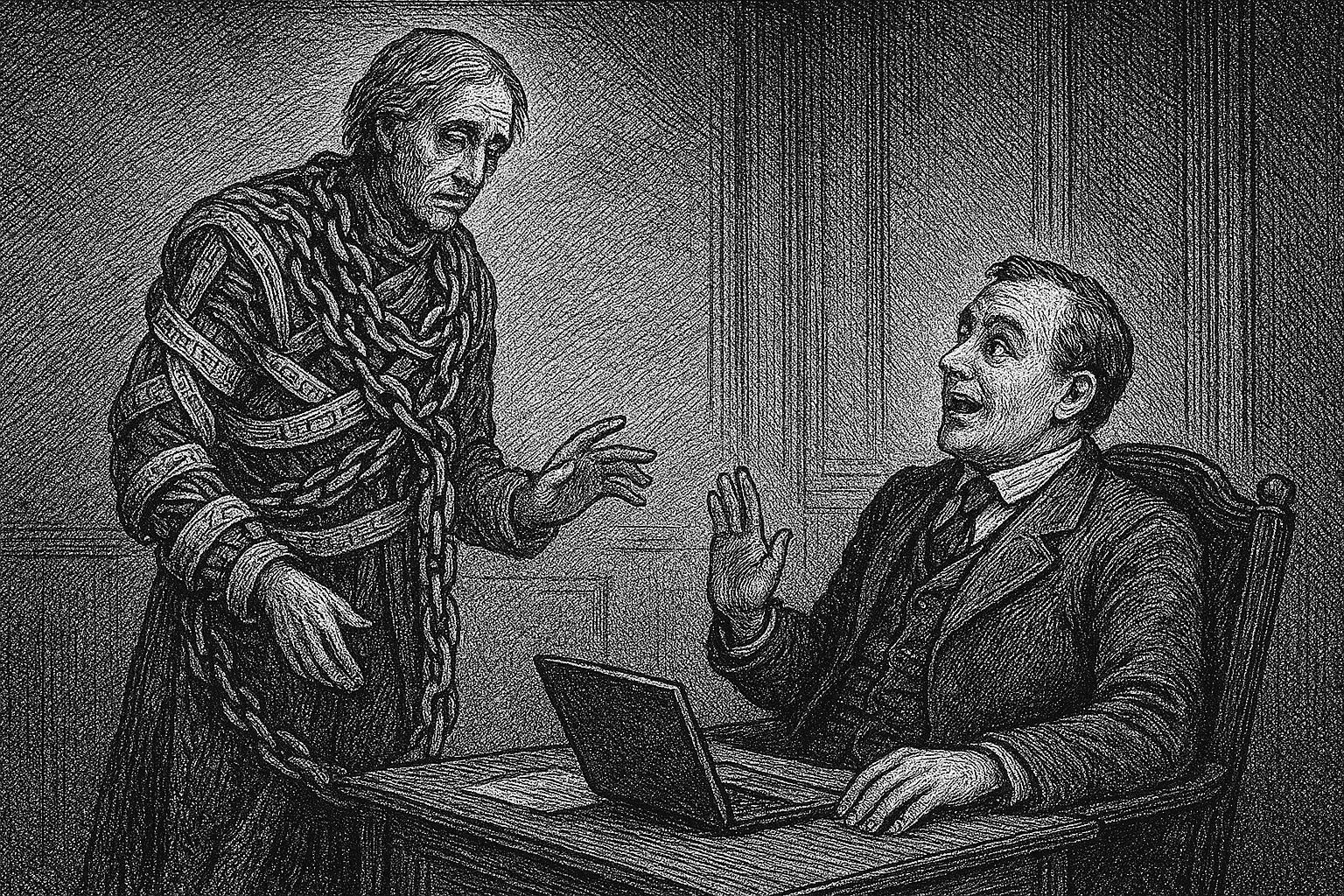
Scrooge stared at the chains, unsettled by questions he could not answer.
“You will be visited,” said Marley, “by three spirits. Listen to them. See what they show you. Learn what I learned too late.”
And with that, Marley began to fade, his chains rattling one final time.
“Remember, Scrooge,” came his voice, already distant, “I showed you how to rise. But I never asked if the climb was worth it.”
Then he was gone, and Scrooge was alone in the darkness, waiting for the first spirit to arrive.
The first of the three spirits
The first spirit came as the clock struck one.
Scrooge awoke to find his room filled with a strange, soft light, and in that light stood a figure of peculiar aspect: it wore the appearance of a much younger person, yet carried about it an air of great age and wisdom.
“I am the Ghost of Product Management Past,” said the Spirit. “Rise, and walk with me.”
They passed through walls and time itself, until they stood in an office Scrooge recognised - his own office, but years ago, when he was but a lowly Product Manager himself.
There sat his younger self, and opposite him sat Belle. Bold, brilliant Belle, who read signals in customer behaviour that others missed.
“I know this,” said Scrooge. “This was the quarter we delivered the Customer Insights platform.”
“Watch,” said the Ghost.
Belle spread papers across the desk - research findings, user interviews, early usage data. “The data is telling us that building what we promised won’t solve the customer problem. We need to pivot. Early tests are telling us the user experience is too complex and the insights we’re returning don’t make sense to them. We need to solve these problems before we launch. It’ll take another six weeks.”
“Six weeks?” The younger Scrooge’s voice was hard. “Belle, we promised stakeholders delivery in three weeks. The roadmap is set.”
“But if we deliver something that doesn’t work—”
“It works perfectly well. This is what happens when we let perfect be the enemy of the good. We ship what we planned. We honour our commitments.”
The older Scrooge watched as his younger self brought in additional oversight - daily check-ins, tighter controls, detailed progress reports. Watched as the platform shipped on time, celebrated by stakeholders who did not yet know that users would abandon it within months. Watched as Belle became more silent and passive as the project was delivered. Watched as, three weeks after that launch, she handed in her resignation.
“She lacked resilience,” the younger Scrooge told senior leadership. “She couldn’t handle the pressure.”
“What else could I have done?” said Scrooge to the Spirit. “The commitment was made. Belle wanted to change everything at the last moment - that’s not how things work. Stakeholders were counting on us.”
The Spirit said nothing, but moved forward through time to a different office, larger and brighter. There was Belle - older now, more assured - presenting to a room of executives. The metrics behind her told a story of competing trade-offs as she talked them through the product strategy.
“This is Belle’s company now,” said the Spirit. “She found a place that valued courage over compliance. That rewarded her for changing course when evidence demanded it.”
“She learned to manage her stakeholders,” muttered Scrooge, but he could not meet the Spirit’s gaze.
“You learned what Marley taught you,” said the Spirit. “ But you never questioned what you were learning to do.”
The light began to fade, and Scrooge found himself back in his room, alone and unsettled in ways he could not name.
The second of the three spirits
The second spirit came as the clock struck two.
This spirit was large and jovial, dressed in robes that seemed woven from status updates and sprint reports. “I am the Ghost of Product Management Present,” it boomed. “Come!”
They stood in a conference room - Scrooge’s own conference room. Bob Cratchit was leading a retrospective. Around the table sat his team, including young Timothy, an associate product manager barely six months into his role, taking assiduous notes of all that passed.
“Right,” said Bob, and his voice carried a weariness that made Scrooge lean forward. “Let’s be honest with each other. The deadline for the Recommendation Platform is in four weeks. We’ve been off track for the last month, and we haven’t been able to pull it back in. What can we do?”
The team exchanged glances. Sarah, the tech lead, spoke carefully: “We could use a simpler model than what we scoped. It’ll work, but not well. It won’t scale. We’ll spend the next quarter being killed by performance issues.”
“And if we tell Scrooge we need another month to do it properly?”
The silence that followed made Scrooge’s chest tighten.
Bob sighed, and something in that sigh pierced Scrooge more deeply than he expected. “So we ship a simpler model in four weeks. We document the technical debt. We’ll fix it later.”
“Will we?” asked a developer, and his skepticism hung in the air like smoke.
“We’ll try to find some capacity,” said Bob, and everyone at that table knew what those words meant.
Tiny Tim closed his notebook, and Bob caught his eye as he left the room. Something passed between them - not words, but understanding. Scrooge saw it clearly: the lesson being learned, the pattern being set. How to protect the team and manage upward. How to make sure the stakeholders got what they wanted, and finding ways to limit the cost to the team.
Scrooge felt something cold settle onto his chest as he followed the Ghost and Bob into his own office, watching himself smile as Bob showed him a plan and a series of status updates. All green. He watched Bob sigh as he left the room, his eyes hollow.
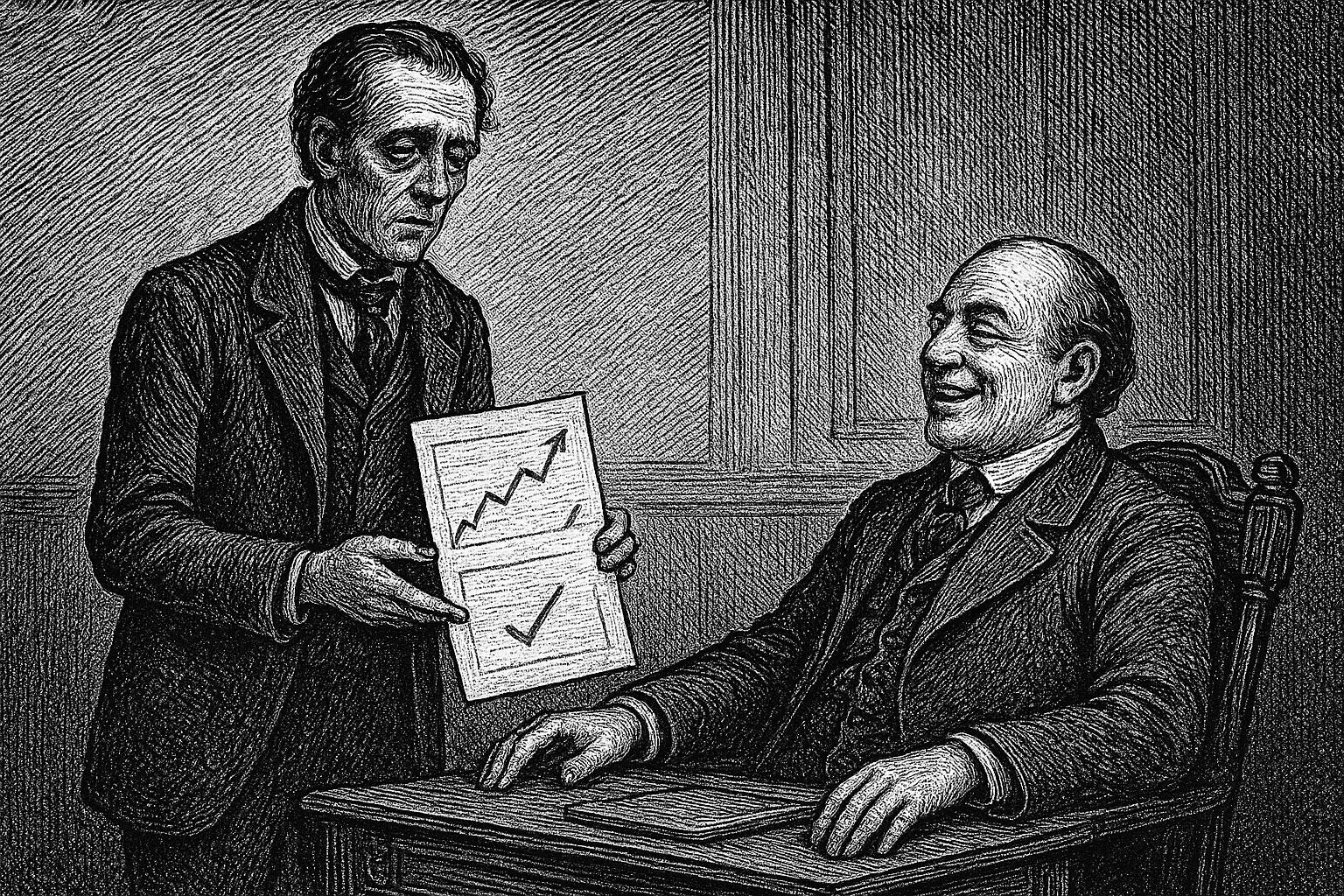
“Spirit,” said Scrooge, his voice catching. “Tell me these people will be well. Tell me that Tim can grow, that Bob - “
“Perhaps they lack resilience,” said the Ghost, and Scrooge flinched at hearing his own words. “Perhaps they cannot handle the pressure.”
Scrooge hung his head, overcome with shame at hearing his own words.
“I never told them to lie,” he said weakly.
“You told them that pushing back was unacceptable,” said the Ghost. “You told them, as you told Belle, that commitments must be honoured above all else. They heard you clearly, Scrooge. They heard you very clearly indeed.”
“The boy,” said Scrooge, and his voice trembled. “What becomes of Tim?”
But the Spirit was already fading, and Scrooge was left alone with the image of Tiny Tim writing in his notebook, learning all the wrong lessons from watching all the wrong examples.
The last of the spirits
The third spirit came as the clock struck three.
This spirit spoke not at all, and Scrooge feared it most of all. It was shrouded in darkness, pointing ever forward with a hand that seemed to promise only dread.
“Spirit,” said Scrooge, “I fear you more than any spectre I have seen. But I know your purpose is to do me good. Lead on!”
They stood in a bright, modern office. Through the glass wall, Scrooge could see Belle’s name on the door of the corner office. This was her company.
And in a smaller room, Tim was speaking to a younger product manager. Papers spread between them, but Tim was shaking his head.
“I know we’re behind,” Tim was saying. “But we need to think about how we present this. Belle’s expecting to hear we’re on track. Let’s focus the update on what’s going well.”
“But the customer feedback -”
“Add their comments to the backlog. We’ll address them later. Right now, we tell her what she needs to hear.”
And Scrooge watched as the younger PM nodded, learning. As Tim forged another link in the chain Marley had first made.
“No,” whispered Scrooge. “No, he can’t have—”
But the Ghost showed him more. Tim in a different meeting, driving out a talented PM who dared to suggest they needed to replan. Tim presenting dashboards to Belle that showed progress while his teams quietly despaired. Belle sharing the data with her stakeholders.
“And Bob?” whispered Scrooge. “Where is Bob in this future?”
The Ghost gestured to a figure Scrooge had not noticed: older, greyer, sitting alone in a café at three in the afternoon on a Tuesday. Not working. Not anywhere. Just sitting, staring at nothing, burned out and gone.
“Spirit!” cried Scrooge, clutching at the phantom’s robes. “Are these the shadows of things that will be, or are they shadows of things that may be only? Men’s courses will foreshadow certain ends, to which, if persevered in, they must lead. But if the courses be departed from, the ends will change. Say it is thus with what you show me!”
The Spirit’s hand trembled.
“Good Spirit,” Scrooge pursued, “tell me that I may yet change these shadows! Tell me I can undo what I have done!”
The Spirit pointed directly at Scrooge himself - not at the future, but at the man standing before it now. The message was clear as any words: the choice was his. Had always been his. Would always be his.
The end of it
When Scrooge awoke, it was Christmas morning, and he was in his own bed, in his own room. The relief that flooded through him was as powerful as any joy he had ever known.
“I am myself again!” he cried. “The spirits have given me a chance, and I shall not lose it!”
He looked at his computer, where the Christmas Day stakeholder reports sat ready to send - all those carefully curated updates, all that theatre of success. He had promised stakeholders their reports, even on Christmas Day. He had never disappointed stakeholders.
But he had disappointed his people. He had disappointed Belle, and Bob, and Tim. He had disappointed himself.
Scrooge opened a new message. His hands shook as he began to type.
He would begin today. This very morning. He would tell his stakeholders that the project was off track. That he had set the deadline without proper foundation. That he had prioritised their satisfaction over his team’s ability to do good work. That he was sorry, and that he was asking them to trust him to make it right.
It was the most terrifying message he had ever written.
He sent it before he could lose his nerve.
Then he went to find Bob.
It would not be easy. The lessons of years could not be unlearned in a day. But Scrooge had seen enough - had been shown enough - to know that change must come.
And Tim? Tim would have a different teacher now. One who could teach him that listening to signals and changing course when evidence demanded it was courage, not weakness. That strength meant admitting error. That the greatest waste was not missed deadlines, but wasted potential.
Scrooge kept Christmas well, if any man alive possessed the knowledge of how to keep it. And it was always said of him afterwards that he knew how to build trust, how to honour evidence over ego. Some laughed to see the alteration in him, but he let them laugh, and thought the better of it. For his own heart laughed with them, and that was quite enough for him.
May that be truly said of us, and all of us!